

Asset Inventory
Hardware, software, vulnerabilities and historical comparisons collected for a specific Argus Client.

Enterprise IT asset register
Bring registered assets and devices discovered by Argus sources into a verification process, then keep responsibility, criticality, lifecycle and technical context in one enterprise register that can be searched, reviewed and documented.

Two levels, two purposes
Asset Inventory and Asset Inventory Company work together, but answer different questions. The first describes an individual endpoint; the second builds and governs the consolidated enterprise register.
Hardware, software, vulnerabilities and historical comparisons collected for a specific Argus Client.
Detected or entered assets, correlated sources, owners, users, locations, criticality, status and CIS verification in one enterprise register.
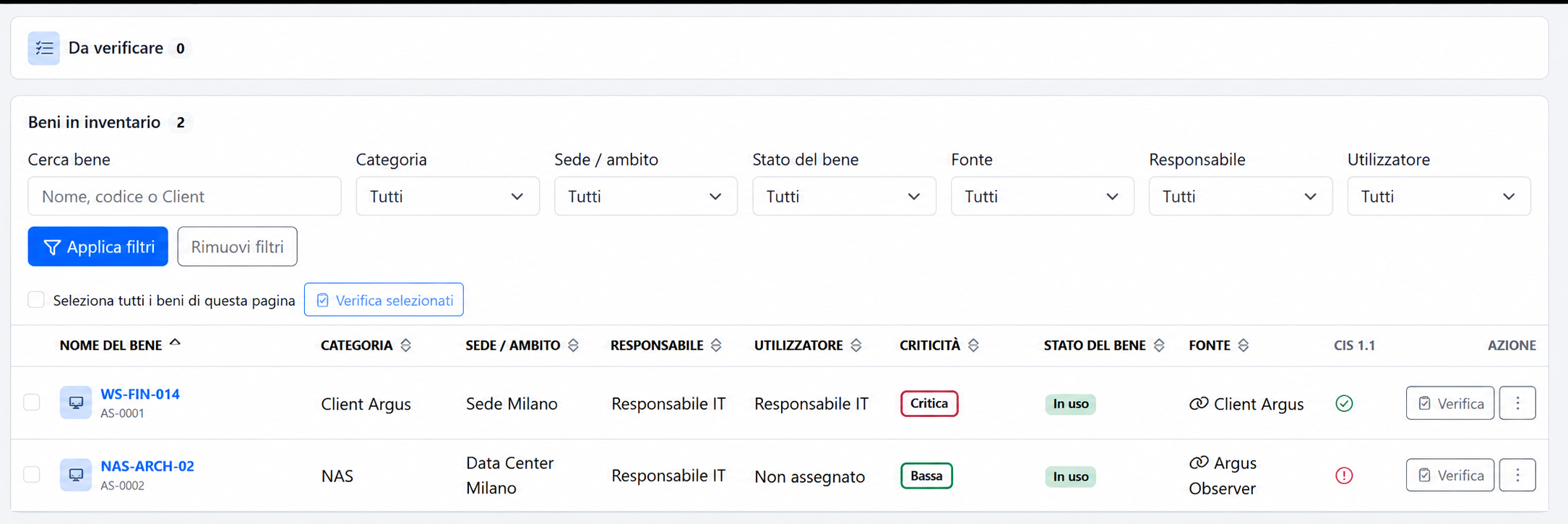
The consolidated view lets teams search and filter the estate by category, location, status, source, owner and user. Criticality and CIS verification remain visible without opening every record.
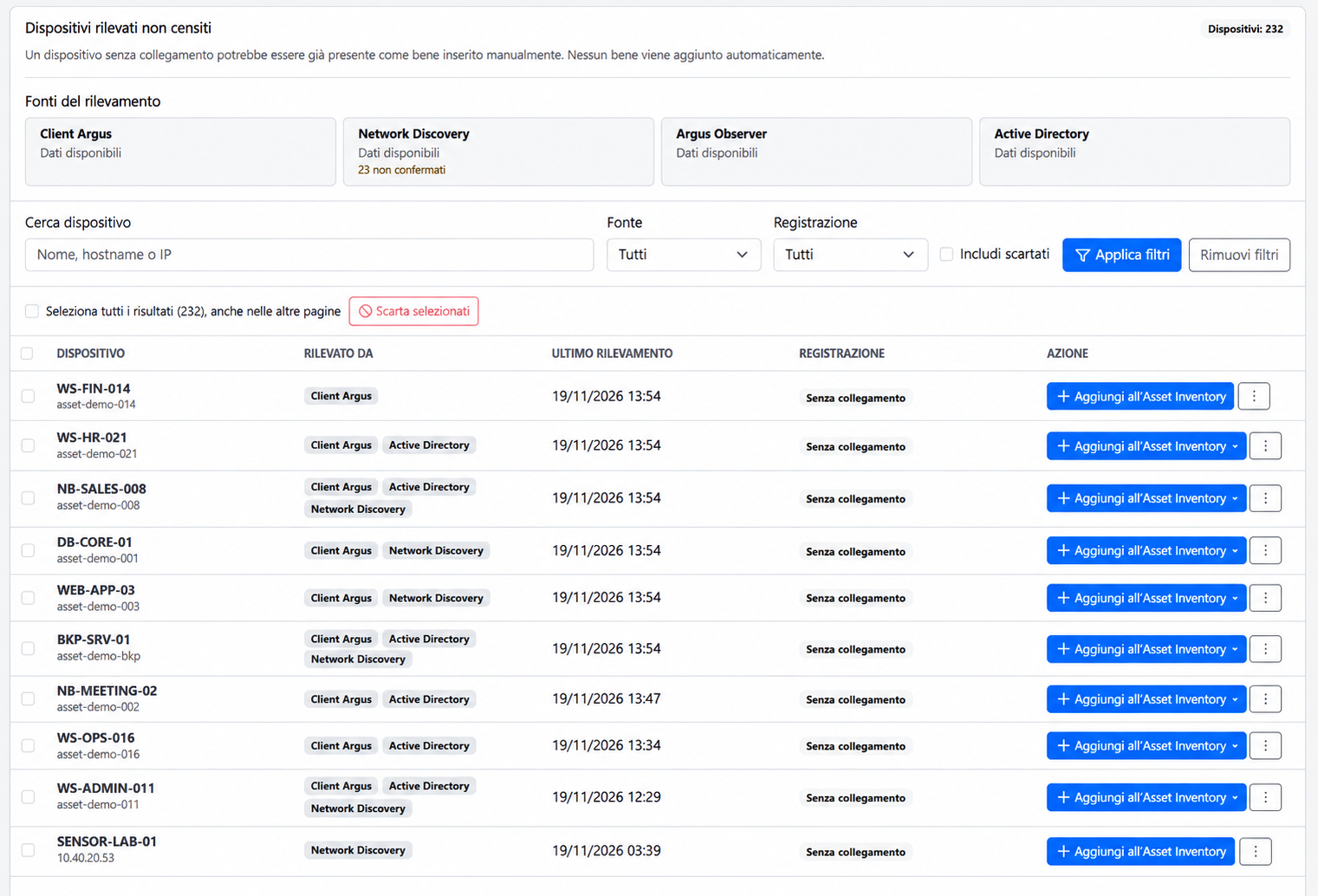
Argus Client, Network Discovery, Argus Observer and Active Directory may observe the same device from different perspectives. Asset Inventory Company does not automatically turn every signal into an asset: it proposes discovered items and preserves human control over registration and matching.
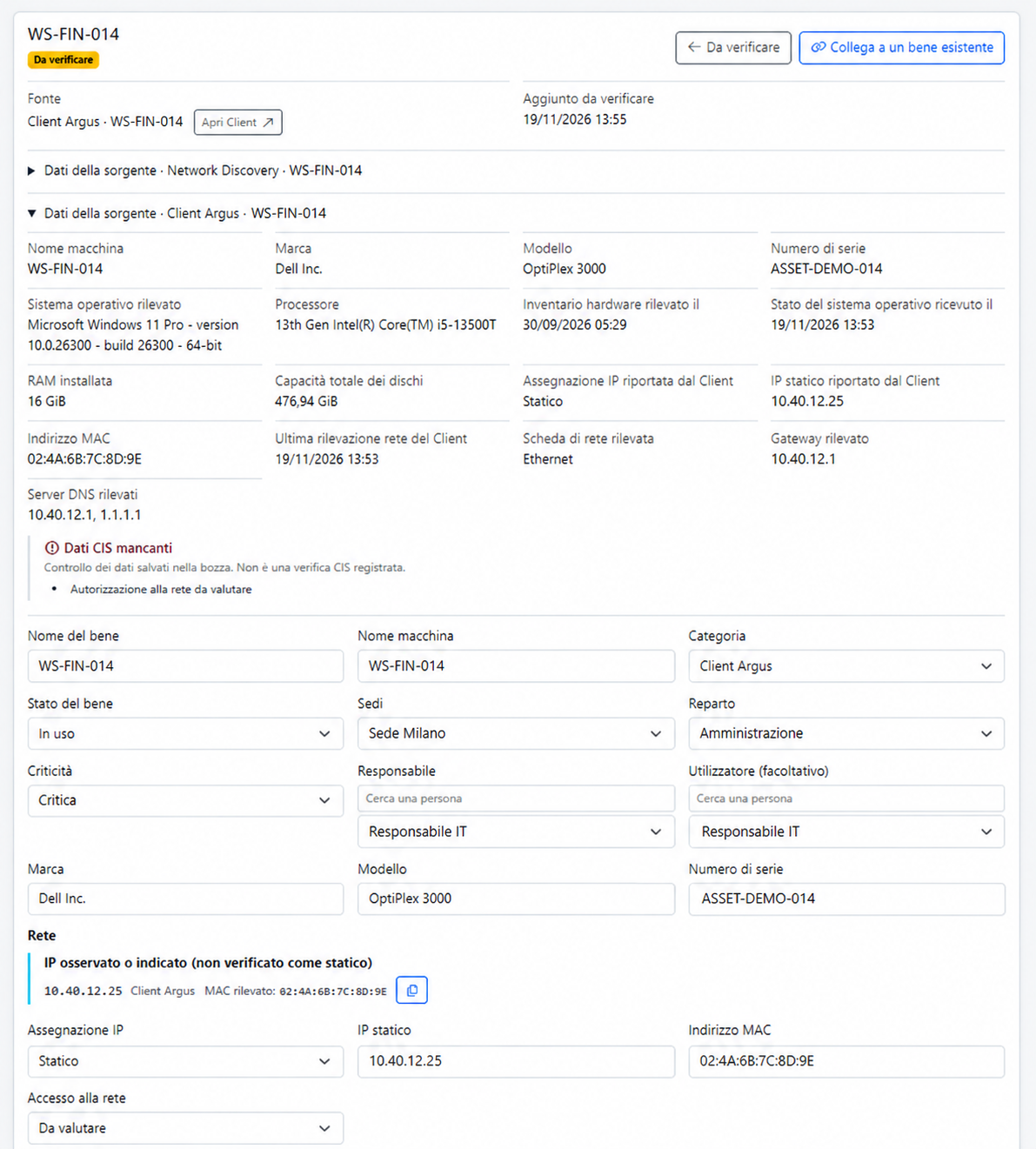
The record brings available data together, highlights missing information and allows the asset to be assigned to a location, department, owner and user. An operator can confirm values, correct them or match the device to an existing asset.
The same estate can be organized to support different operational, documentation and control needs.
Managed, manually entered or discovered assets with enterprise identity and lifecycle status.
Separates approved assets from discovered items that still require a decision.
Makes placement, responsibility and assigned user explicit so no asset remains ungoverned.
Surfaces high-criticality assets and records with mandatory fields missing or unverified.
Organizes Clients, servers, NAS, network equipment, virtual systems and agentless devices.
Produces documentable extracts and preserves the asset verification and update path.
Asset Inventory Company helps build and maintain a detailed inventory of enterprise assets. The CIS profile makes completeness, freshness and missing fields visible before a verification is recorded.
Asset management is one of the measures referenced by Article 21 of the NIS2 Directive. A maintained register supports risk analysis, vulnerability management, incident response and operational continuity by keeping assets, responsibilities and criticality identifiable.
The register remains governed by authorized users. AIE can assist data interpretation and guide checks without replacing approvals or accountability.
Finds assets without an owner, location, criticality or other required information.
Highlights similar items observed by different sources before registration.
Helps distinguish an active asset from a record that has not been observed for too long.
Summarizes criticality, missing data and context to make the work queue easier to read.